Pinniped etiketine sahip kayıtlar gösteriliyor. Tüm kayıtları göster

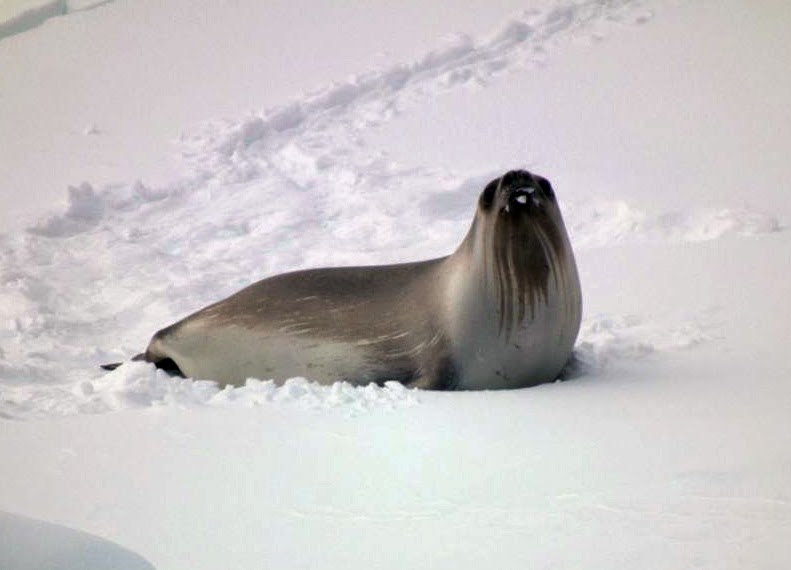
Ross Seal

Omnatophoca rossii
The Ross Seal is one of the least studied Seal species native to the pack ice of Antarctica. They are less common overall than the Weddell and Leopard Seals, and because they tend to live alone they have a very low population density.

Ross Seals are also smaller in size than many other their cousins. They rarely grow larger than 2m in length, which is as much as 5ft shorter than the Leopard Seals. They do, however, have incredibly large eyes. In fact, their genus name, Omnatophoca roughly translates to "Eye Seal," because they can grow up to 7cm in diameter!

Another interesting anatomical feature of the Ross Seal is its voice. They can create some really interesting siren-type noises, both on land and underwater. Because these noises carry for long distances, scientists believe that the Seals use them to either locate other Seals, or to warm them away from their territory.

Ross Seals are listed as being of Least Concern, but because they are uncommon and not well studied we don't really know much about their population size or its trends. Estimates suggest anywhere from 100,000-250,000 individuals.

IUCN Status : Least Concern
Location : Antarctica
Size : Length up to 6.6ft (2m), Weight up to 450lbs (204kg)
Classification : Phylum : Chordata -- Class : Mammalia -- Order : Carnivora
Family : Phocidae -- Genus : Ommatophoca -- Species : O. rossii
Image :  Dave Buller

Weddell Seal

Leptonychotes weddellii
For the last week or so we've been learning about animals that live in mountain rainforests. This week let's totally mix it up and move to a completely different ecosystem and location entirely-- Antarctica.Our southernmost continent doesn't harbor a ton of year-round terrestrial life, but it is the migratory home of several different birds, and it is surrounded by waters that are teeming with life of all types.

The Weddell Seal is one of those marine animals that makes Antarctica its home. These large, docile mammals live further south than any other Seal, and they tend to stick close to home-- most never move more than a few miles from where they were born.

Weddell Seals take advantage of the rich waters surrounding Antarctica. They hunt Cod, Silverfish, Octopus, Crab, and many other sea creatures. While searching for food they can dive as far as 2,000ft, and stay under for 45 minutes. An adult Weddell Seals eats anywhere from 20-110lbs of food every day!

You'd think a 10ft, 1,000lb mammal would be near the top of the food chain-- but Weddell Seals have predators of their own! Orcas and Leopard Seals love to track them down, so they have to be careful while fishing and especially while raising their young. Little Weddell Seals grow fast-- they can swim at 2 weeks -- but they aren't weaned or able to hunt on their own for another month after that.

IUCN Status : Least Concern
Location : Antarctica
Size : Length up to 10ft (3m), Weight around 1,100 lbs (500kg)
Classification : Phylum : Chordata -- Class : Mammalia -- Order : Carnivora
Family : Phocidae -- Genus : Leptonychotes -- Species : L. weddellii
Image :  NOAA

Puijila darwini

Though it may not look like it, the animal in that picture-reconstruction is an ancestral Seal! Yes, Seal! The finned, sleek bodied ocean mammals! In fact, it is the most ancient Seal ever found.

Puijila darwini was only discovered in 2007, so it is a pretty recent find. Amazingly, only one fossil has been uncovered so far-- but the skeleton was almost totally complete! It was found in Nunavut, Canada.

Puijila lived a semi-aquatic carnivorous lifestyle. It had webbing on all four feet, and swam by paddling through the water. It is an interesting fossils not just because it is the most primitive Seal known, but also because it is an example of a transitional species. All land animals evolved from sea-dwelling creatures, and Seals and Whales are examples of mammals that returned to the sea. Puijila was a step between fully land-dwelling Carnivore and the eventual ocean-dwelling Pinnepeds.

Status : Extinct, lived 21-24 million years ago
Location : Canada
Size : Length up to 3.3ft (1m)
Classification : Phylum : Chordata -- Class : Mammalia -- Order : Carnivora
Suborder : Pinnipedimorpha -- Genus : Puijila -- Species : P. darwini
Image : Smokeybjb

New Zealand Sea Lion

New Zealand Sea Lions, also sometimes called Hooker's Sea Lions, are the rarest and most vulnerable Sea Lions in the world. It is estimated that only 10,000 still remain, no thanks to decades of human hunting, being scooped up as bycatch for the commercial fishing industry, and bad-luck natural disasters.

Phocarctos hookeri
As the name states, these Sea Lions are found in New Zealand, specifically near the southern, aubantarctic islands. In fact, nearly the entire populations breeds at three colony sites on the Aukland Islands.

Breeding takes place from November to February. The males come ashore first to stake out spots, with the largest, strongest males claiming the most territory and the most number of mates. (Males can grow twice as large as females, if not bigger) Females (who are usually pregnant) arrive soon after. They give birth to a pup, and then breed again 1-2 weeks after.

One standout fact is that during this entire breeding season, the males do not feed. Females return to the water to bring food back for themselves and their growing pups, but the males risk losing their territory if they leave. This is another reason why the largest males tend to be more successful-- they have greater fat stores to sustain them during the summer.

New Zealand Sea Lions are listed as Vulnerable, and their are a handful of actions being taken to keep them safe. Their breeding grounds are now protected, hunting has been banned, and work is being done to prevent them from being captured in fishing nets. Unfortunately, disease has also stricken the Sea Lions-- several different bacterial diseases have spent through the colonies in the past 20 years. The worst, in 1998, killed 53% of all newborns and 20% of breeding females. There is a bright side though-- births in 2013 were the highest they had been in 5 years, and Sea Lions are starting to breed again on islands that had long been absent of colonies.

IUCN Status : Vulnerable
Location : New Zealand
Size : Male body length up to 11ft (3.3m), female up to  6.6ft (2m)
Classification : Phylum : Chordata -- Class : Mammalia -- Order : Carnivora
Family : Otariidae -- Genus : Phocarctos -- Species : P. hookeri
Image : Tomas Sobek  Brocken Inaglory