Arthropod etiketine sahip kayıtlar gösteriliyor. Tüm kayıtları göster

Hairy Scorpion

Hadrurus arizonensis
Meet the largest Scorpion in North America-- the Hairy Scorpion. These arachnids can grow over 5in long, and their large size makes them quite the predator within their desert habitat. They feed on smaller invertebrates (including other Scorpions) and will even hunt snakes, lizards, and small vertebrates as well.

Hairy Scorpions are named for the dark brown hairs that cover the backs of their otherwise yellow-ish bodies. Their coloration helps them to blend in with the dry environment that they live in. You'll find these Scorpions in the Mojave and Sonora Deserts.

The large pincers on these arachnids are used for more than just grasping at food. These guys are excellent burrowers, and can dig tunnels that are more than 2m in length. They hang out in them during the daytime, emerging at night to hunt.

Even though they are large in size, the Hairy Scorpions shouldn't frighten you. Their sting is venomous, but tends to be no worse than a beesting for the average person.

IUCN Status : Not Listed
Location : North America
Size : Length around 5.5in (14cm)
Classification : Phylum : Arthropoda -- Class : Arachnida -- Order : Scorpiones
Family : Caraboctonidae -- Genus : Hadrurus -- Species : H. arizonensis
Image :  Fritz Geller Grimm

Belgica antarctica

Belgica antarctica
Did you know that insects do live on Antarctica? You may have assumed that the cold weather would scare the tiny invertebrates away from the continent, but you would've assumed wrong! Today's animal is one of a handful of little Arthropods that make our southernmost landmass home year round.

Belgica antarctica has the important distinction of being the largest terrestrial-only inhabitant of Antarctica-- at a whopping 6mm in length! These insects have some seriously amazing adaptations that allow them to survive in the hard environment-- they can go without oxygen for several weeks, they can survive their bodily fluids freezing, and they are able to produce specific compounds that keep that freezing to a minimum.

Warm temperatures are actually harmful to B. antarctica. They need to stay close to freezing in order to thrive. If it gets too cold though, they are in trouble. Luckily, they spend nearly all of their time just under the surface of the snow, which keeps the heat to within a few degrees of freezing.

Belgica antarctica can live up to 2 years, and spends most of that time in four different larval stages. As adults their lifespan in very short-- only around 10 days. They live just long enough to mate and lay eggs before dying.

IUCN Status : Not Listed
Location : Antarctica
Size : Length up to 6mm
Classification : Phylum : Arthropoda -- Class : Insecta -- Order : Diptera
Family : Chironomidae -- Genus : Belgica-- Species : B. antarctica
Image :  Richard Lee

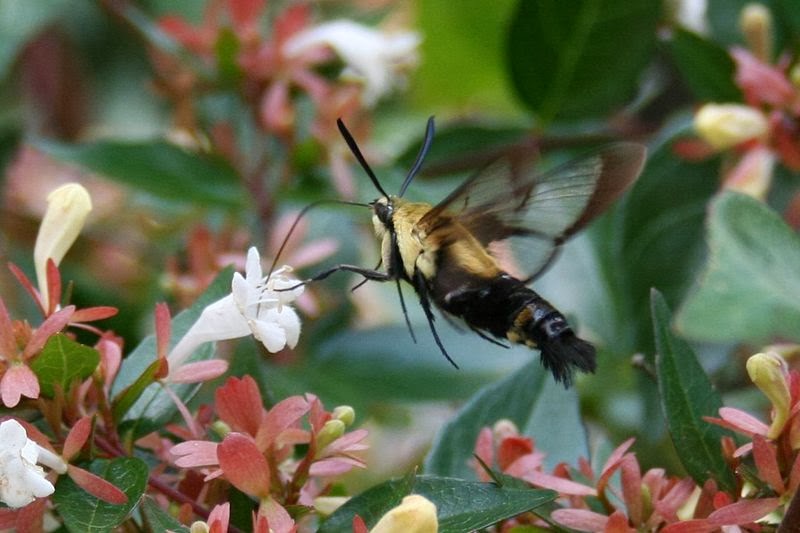
Snowberry Clearwing

Hemaris diffinis
The Snowberry Clearwing is a species that belongs to a group collectively known as "Hummingbird Moths."

You can identify this particular species by it's furry yellow and black banded body that can be anywhere from 1-2 inches in length. They also have wings that appear to be clear, due to a lack of scales (hence the common name).

Snowberry Clearwings live in most of the United States, and in parts of western Canada. As pupae they feed plants like Snowberry and Honeysuckle. As adults they drink nectar, hovering in place like a Hummingbird. They are most commonly seen during the daytime hours.

IUCN Status : Not Listed
Location : North America
Size : Length up to 2in (6cm)
Classification : Phylum : Arthropoda -- Class : Insecta -- Order : Lepidoptera
Family : Sphingidae -- Genus : Hemaris -- Species : H. diffinis
Image : Lonniehuffman

Chinese Mitten Crab

Eriocheir sinensis
Today we're going to learn about the Chinese Mitten Crab-- a Crustacean named for its large, furry front claws.

You may not think too much about the environmental impacts this crab, whose body is about the size of a fist, but they are actually a very troublesome invasive species! Chinese Mitten Crabs are native to eastern Asia, but they have now spread to Europe and North America as well.

Chinese Mitten Crabs are troublesome because they make large migrations, displacing native species at every step of the journey. They breed in the oceans, grow up in freshwater rives, and hatch in estuaries. Due to their movements they can even be found hundreds of miles from the sea! In all of those different habitats the Crabs compete with native species for food and burrows. They also damage fishing nets, and have caused that industry to lose great amounts of money.

Not everyone is frustrated with the Chinese Mitten Crabs though-- they are a delicacy in parts of China and some can sell for over $100 a kilogram!

IUCN Status : Not Listed
Location : Native to Asia
Size : Carapace up to 4in (10cm) in diameter
Classification : Phylum : Arthropoda -- Class : Malacostraca -- Order : Decapoda
Family : Varunidae -- Genus : Eriocheir -- Species : E. sinensis
Image : NHM

Pacific Cleaner Shrimp

Lysmata amboinensis
The Pacific Cleaner Shrimp is a Crustacean of many, many names. Their list of alias includes the Skunk, Scarlet, and Northern Cleaner Shrimp (because of their location and identification).

The "Cleaner" part comes from the fact that these small, 2in long Shrimp feed on dead tissue, debris, and parasites of much larger aquatic species. In fact, larger fish are known to seek out the reefs that the Pacific Cleaner Shrimp live on, just so the shrimp can help to  get rid of trobulesome parasites! They will even go inside of a fishes' mouth!

Pacific Cleaner Shrimp are found in the tropical waters of the Indian and Pacific Oceans. They live relatively close to the surface, hanging out in the coral reefs.

Amazingly, every single Pacific Cleaner Shrimp is born male. As they age they go through metamorphosis and molt, and eventually becoming hermaphrodites.

IUCN Status : Not Listed
Location : Tropical Indo-Pacific Waters
Size : Length up to 2in (6cm)
Classification : Phylum : Arthropoda -- Class : Malacostraca -- Order : Decapoda
Family : Hippolytidae -- Genus : Lysmata-- Species : L. amboinensis
Image : Chris Moody

Anomalocaris

Anomalocaris
Anomalocaris is the name of a genus that lived during the Cambrian period... over half a billion years ago!

These ancient relatives to the arthropods of old swam in the seas that covered the planet. Their fossils have been found in places that are (now) as far apart as Canada, China, and Australia.

Anomalocaris grew up to 3ft in length, and had a segmented body that allowed it to swim using an undulating motion. They also had complex, stalked eyes, and two arms covered in barbs that extended from the mouth. The mouth itself was circular, and may have been able to crush hard-bodied prey like Trilobites.

The interesting anatomical features of Anomalocaris made it difficult to identify for many, many years. Different body parts were found independent from one another, and were actually attributed to several different animals, including Jellyfish and Crustaceans. While the first fossils were discovered in 1892, it took until 1985 for scientists to realize all of those fossils belonged to the same animal!

Status : Extinct, lived during the Cambrian ~500 million years ago
Location : Worldwide
Size : Length up to 1m
Classification : Class : †Dinocaridida -- Order : †Radiodonta
Family : †Anomalocarididae -- Genus : †Anomalocaris
Images : Worldlesstech

Ox Beetle

The Ox Beetle is a species of Rhinoceros Beetle that can be found in North, Central, and South America. They are medium-sized for their subfamily-- only growing to about 4cm in length, as opposed to their largest cousins which can be half a foot long! Interestingly though, they are still one of the largest Beetles in North America.

Ox Beetles  are sexually dimorphic, with males having much larger horns. There are actually two different types of male-- one with very large horns (the "major" variety) and one with shorter, stubbier ones ("minor").

Both sexes are great diggers, and they even bury their eggs underground. The Beetles typically stay in their larval stage for about a year, and during that time they feed on decaying vegetation. As adults they will only live 4-6 months (typically during summertime), and spend that time breeding and eating leaves and fruit.

IUCN Status : Not Listed
Location : North and South America
Size : Length up to 4cm
Classification : Phylum : Arthropoda -- Class : Insecta -- Order : Coleoptera
Family : Scarabaeidae -- Genus : Strategus-- Species : S. aloeus
Image : Shawn Hanrahan

Dark Sword-grass

Meet the Dark Sword-grass, a moth that can be found in temperate regions all around the world, and which also happens to be quite the pest while in its larval stage.

Many moth species stick to a specific plant-type while in their larval stage. Not so for this insect! They feed on grasses, weeds, fruits, grains, vegetables, and many, many other plants. Understandably, they can be quite the pest in agricultural areas. They like to feed on the crops near ground level, which can very quickly kill the plant!

As adults they are far less damaging-- they consume flower nectar. Their adult stage also has the interesting distinction of being one of the fastest flying insects! They can sustain ground speeds of 70mph!

IUCN Status : Not Listed
Location : Worldwide
Size : Wingspan up to 5cm
Classification : Phylum : Arthropoda -- Class : Insecta -- Order : Lepidoptera
Family : Noctuidae -- Genus : Agrotis -- Species : A. ipsilon
Image : M. Virtala

Julia Butterfly

The Julia Butterfly is an insect with a very large range that spreads from the southern United States all the way down to Brazil. They are residents in most of their range, though in the U.S. they sometimes move north to Midwestern states during the summer.

Both male and female Julia Butterflies are orange, though the males are more vibrant. They have a black border that runs around the edge of the wing, though the exact pattern varies with the subspecies.

You'll find Julia Butterflies living in grasslands and near forest edges. They are fast flyers, and as adults they scurry about in the daytime in search of both mates, and nectar to feed on. As caterpillars they consume Passion Vines.

Julia Butterflies are not listed by the IUCN, but they are abundant through most of their range. The population only really dips when it gets to the fringe areas.

IUCN Status : Not Listed
Location : North and South America
Size : Wingspan up to 9cm
Classification : Phylum : Arthropoda -- Class : Insecta -- Order : Lepidoptera
Family : Nymphalidae -- Genus : Dryas -- Species : D. iulia
Image : A Machado

Eurypterus

Eurypterus sp.
The world of the Silurian period was very different from the world of today. Most noticeably, there were no land animals. All of the living animals could be found underwater, populating the oceans that covered many of our present continents.

In these oceans you could find all sorts of primitive life. Bony fish were just starting to make their appearance on the evolutionary timeline, for example. You could also find a massive array of invertebrates, including the members of the genus we'll be learning about today-- Eurypterus.

Eurypterus includes 15 different species of Sea Scorpion, all of whom lived between 432 and 418 million years ago. Their fossils have been uncovered in what is now eastern North America and Europe, and interestingly the first fossils dug up were confused for Catfish bones!

When we think about Scorpions today, we imagine small arachnids that are about the size of your hand. Eurypterus was much, MUCH larger. On average, the different species measured 1-2ft in length. However, the largest fossil showed a creature that was over 4ft long!

Eurypterus had a body made up of two segments-- the prosoma and the opisthosoma. The former contains the head, thorax, and appendages that are used for walked, eating, and swimming. The latter is segmented and contains the gills and reproductive organs.

Members of the genus were opportunistic feeders-- they both hunted and scavenged. While they could swim using their large paddle-like appendages, they did not swim in order to hunt. Eurypterus walked along the sea floor when it was searching for food.

The Eurypterus genus only lasted for 14 million years, which is a short amount of time when compared to other members of its Order. Amazingly though, despite that short amount of time they are the most represented Eurypterids in the fossil record-- nearly 95%!

Status : Extinct for 418 million years
Location : Europe, North America
Size : Length up to 4.3ft (1.3m)
Classification : Phylum : Arthropoda -- Class : Merostomata -- Order : †Eurypterida
Family : †Eurypteridae -- Genus : †Eurypterus
Image : Funkmonk

17 Year Cicada

Magicicada septendecim
There are a handful of Cicacads known as "periodicals," and the 17 Year is the largest and most northern living of the group.

These insects get their name from their long and unusual life cycle. For seventeen years you will never see them. The entire population will live underground as Juveniles, and then all at once they emerge as adults to breed and start the cycle over. And interestingly, though they live nearly two decades as juveniles, their adult life lasts only a few weeks-- just long enough to breed and lay eggs.

The timing of the cycle depends on the specific population. For example, one brood near by home state appeared way back in 2002, while another was more recent in 2007. One of the New England broods is even scheduled for 2013. People in North America have been tracking these Cicadas since 1715!

Unfortunately, their long reproductive cycle puts them in conservation trouble. If something were to happen to a brood it could be totally disastrous. For this reason they are listed as Near Threatened.

IUCN Status : Near Threatened
Location : North America
Size : Length up to 1.5in (4cm)
Classification : Phylum : Arthropoda -- Class : Insecta -- Order : Hemiptera
Family : Cicadidae -- Genus : Magicicada-- Species : M. septendecim
Image : Martin Hauser