Insect etiketine sahip kayıtlar gösteriliyor. Tüm kayıtları göster

Belgica antarctica

Belgica antarctica
Did you know that insects do live on Antarctica? You may have assumed that the cold weather would scare the tiny invertebrates away from the continent, but you would've assumed wrong! Today's animal is one of a handful of little Arthropods that make our southernmost landmass home year round.

Belgica antarctica has the important distinction of being the largest terrestrial-only inhabitant of Antarctica-- at a whopping 6mm in length! These insects have some seriously amazing adaptations that allow them to survive in the hard environment-- they can go without oxygen for several weeks, they can survive their bodily fluids freezing, and they are able to produce specific compounds that keep that freezing to a minimum.

Warm temperatures are actually harmful to B. antarctica. They need to stay close to freezing in order to thrive. If it gets too cold though, they are in trouble. Luckily, they spend nearly all of their time just under the surface of the snow, which keeps the heat to within a few degrees of freezing.

Belgica antarctica can live up to 2 years, and spends most of that time in four different larval stages. As adults their lifespan in very short-- only around 10 days. They live just long enough to mate and lay eggs before dying.

IUCN Status : Not Listed
Location : Antarctica
Size : Length up to 6mm
Classification : Phylum : Arthropoda -- Class : Insecta -- Order : Diptera
Family : Chironomidae -- Genus : Belgica-- Species : B. antarctica
Image :  Richard Lee
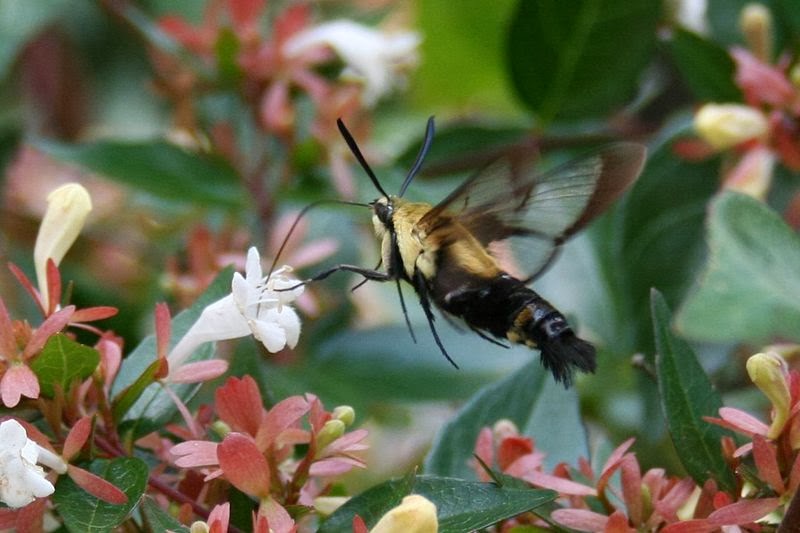
Snowberry Clearwing

Hemaris diffinis
The Snowberry Clearwing is a species that belongs to a group collectively known as "Hummingbird Moths."

You can identify this particular species by it's furry yellow and black banded body that can be anywhere from 1-2 inches in length. They also have wings that appear to be clear, due to a lack of scales (hence the common name).

Snowberry Clearwings live in most of the United States, and in parts of western Canada. As pupae they feed plants like Snowberry and Honeysuckle. As adults they drink nectar, hovering in place like a Hummingbird. They are most commonly seen during the daytime hours.

IUCN Status : Not Listed
Location : North America
Size : Length up to 2in (6cm)
Classification : Phylum : Arthropoda -- Class : Insecta -- Order : Lepidoptera
Family : Sphingidae -- Genus : Hemaris -- Species : H. diffinis
Image : Lonniehuffman

Ox Beetle

The Ox Beetle is a species of Rhinoceros Beetle that can be found in North, Central, and South America. They are medium-sized for their subfamily-- only growing to about 4cm in length, as opposed to their largest cousins which can be half a foot long! Interestingly though, they are still one of the largest Beetles in North America.

Ox Beetles  are sexually dimorphic, with males having much larger horns. There are actually two different types of male-- one with very large horns (the "major" variety) and one with shorter, stubbier ones ("minor").

Both sexes are great diggers, and they even bury their eggs underground. The Beetles typically stay in their larval stage for about a year, and during that time they feed on decaying vegetation. As adults they will only live 4-6 months (typically during summertime), and spend that time breeding and eating leaves and fruit.

IUCN Status : Not Listed
Location : North and South America
Size : Length up to 4cm
Classification : Phylum : Arthropoda -- Class : Insecta -- Order : Coleoptera
Family : Scarabaeidae -- Genus : Strategus-- Species : S. aloeus
Image : Shawn Hanrahan

Dark Sword-grass

Meet the Dark Sword-grass, a moth that can be found in temperate regions all around the world, and which also happens to be quite the pest while in its larval stage.

Many moth species stick to a specific plant-type while in their larval stage. Not so for this insect! They feed on grasses, weeds, fruits, grains, vegetables, and many, many other plants. Understandably, they can be quite the pest in agricultural areas. They like to feed on the crops near ground level, which can very quickly kill the plant!

As adults they are far less damaging-- they consume flower nectar. Their adult stage also has the interesting distinction of being one of the fastest flying insects! They can sustain ground speeds of 70mph!

IUCN Status : Not Listed
Location : Worldwide
Size : Wingspan up to 5cm
Classification : Phylum : Arthropoda -- Class : Insecta -- Order : Lepidoptera
Family : Noctuidae -- Genus : Agrotis -- Species : A. ipsilon
Image : M. Virtala

Julia Butterfly

The Julia Butterfly is an insect with a very large range that spreads from the southern United States all the way down to Brazil. They are residents in most of their range, though in the U.S. they sometimes move north to Midwestern states during the summer.

Both male and female Julia Butterflies are orange, though the males are more vibrant. They have a black border that runs around the edge of the wing, though the exact pattern varies with the subspecies.

You'll find Julia Butterflies living in grasslands and near forest edges. They are fast flyers, and as adults they scurry about in the daytime in search of both mates, and nectar to feed on. As caterpillars they consume Passion Vines.

Julia Butterflies are not listed by the IUCN, but they are abundant through most of their range. The population only really dips when it gets to the fringe areas.

IUCN Status : Not Listed
Location : North and South America
Size : Wingspan up to 9cm
Classification : Phylum : Arthropoda -- Class : Insecta -- Order : Lepidoptera
Family : Nymphalidae -- Genus : Dryas -- Species : D. iulia
Image : A Machado

17 Year Cicada

Magicicada septendecim
There are a handful of Cicacads known as "periodicals," and the 17 Year is the largest and most northern living of the group.

These insects get their name from their long and unusual life cycle. For seventeen years you will never see them. The entire population will live underground as Juveniles, and then all at once they emerge as adults to breed and start the cycle over. And interestingly, though they live nearly two decades as juveniles, their adult life lasts only a few weeks-- just long enough to breed and lay eggs.

The timing of the cycle depends on the specific population. For example, one brood near by home state appeared way back in 2002, while another was more recent in 2007. One of the New England broods is even scheduled for 2013. People in North America have been tracking these Cicadas since 1715!

Unfortunately, their long reproductive cycle puts them in conservation trouble. If something were to happen to a brood it could be totally disastrous. For this reason they are listed as Near Threatened.

IUCN Status : Near Threatened
Location : North America
Size : Length up to 1.5in (4cm)
Classification : Phylum : Arthropoda -- Class : Insecta -- Order : Hemiptera
Family : Cicadidae -- Genus : Magicicada-- Species : M. septendecim
Image : Martin Hauser